
Discover how hydraulic presses work, explore different types including four-column, C-frame, and closed-die presses, and learn expert tips for choosing the right equipment for your manufacturing needs.
Hydraulic presses are versatile industrial machines used for shaping, forming, and compressing materials across various industries. This comprehensive hydraulic press types guide provides an overview of how these machines work, their main configurations, and key considerations for selecting the right equipment for your production requirements.
How Hydraulic Presses Work
Understanding how do hydraulic presses work is essential for making informed decisions about your manufacturing equipment. Hydraulic presses operate based on Pascal’s Law, which states that pressure applied to a confined fluid is transmitted equally in all directions throughout the fluid.
By applying a small force to a pump piston, hydraulic fluid pressurizes and drives a larger main cylinder piston, amplifying the output force significantly. The fundamental formula is:
This principle allows hydraulic presses to generate massive forces—even thousands of tons—with minimal input energy, making them incredibly efficient for heavy-duty industrial applications.
Main Hydraulic Press Types and Their Applications
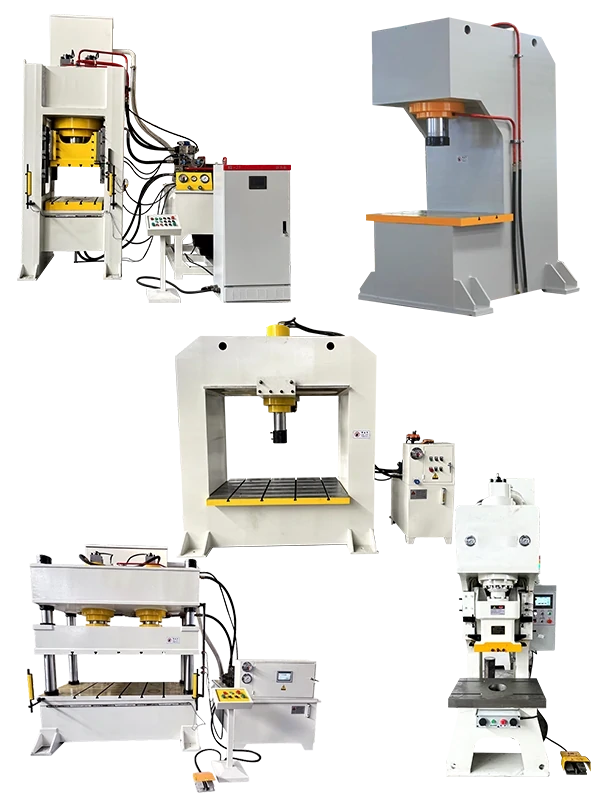
When choosing hydraulic press equipment for your facility, it’s crucial to understand the different hydraulic press types available. Each type offers unique advantages depending on your specific manufacturing needs. Let’s explore the main categories of hydraulic press types in detail.
Four-Column Hydraulic Press
Key Applications:
- Automotive: Car door stamping, engine hood forming, chassis component pressing
- Home Appliances: Refrigerator panel stretching, washing machine tub molding
- Composites: Carbon fiber lamination, fiberglass (FRP) molding
- Metal Forging: Pre-forging of large gears and bearing blanks
✓ Advantages
High resistance to off-center loads, flexible mold setup, excellent stability for mass production, and superior precision for large-scale operations. This is one of the most popular hydraulic press types for heavy-duty applications.
Learn more about our four-column hydraulic press solutions.
C-Frame Hydraulic Press
Key Applications:
- Electronics: Smartphone metal frame stamping, connector pin crimping
- Precision Parts: Bearing pressing, micro-gear forming, assembly operations
- Rubber Products: O-ring vulcanization, silicone button molding
- Light Manufacturing: Punching, bending, and small-scale forming
✓ Advantages
Compact footprint, easy automation integration, 360° accessibility for operators, ideal for precision tasks and quick changeover requirements. Among all hydraulic press types, C-frame models excel in space-constrained environments.
Explore our C-frame hydraulic press collection.
Closed-Die Hydraulic Press
Key Applications:
- Aerospace: Turbine blade hot forging, titanium alloy component forming
- Defense: Armor plate stamping, artillery shell cold extrusion
- Powder Metallurgy: Metal powder isostatic pressing (carbide tools)
- High-Performance Materials: Advanced composite molding
✓ Advantages
High energy efficiency, suitability for extreme temperature conditions, uniform density in formed parts, minimal energy loss during operation. These specialized hydraulic press types are essential for high-precision forging.
Check out our closed-frame hydraulic press options.
Single/Double-Action Hydraulic Press
Key Applications:
- Single-Action: Flat vulcanization, simple punching (metal trays, gaskets)
- Double-Action: Automotive fuel tank deep drawing, stainless steel cookware forming
- Complex Geometries: Multi-stage forming operations
✓ Advantages
Double-action presses significantly reduce wrinkling in complex geometries, provide superior material control, and enable deeper draws without defects. These versatile hydraulic press types are perfect for deep drawing applications.
Comparing Different Hydraulic Press Types
Selecting the appropriate equipment requires careful evaluation of multiple factors. Here’s a comprehensive comparison of hydraulic press types to guide your decision:
| Key Factor | Consideration | Recommended Type |
|---|---|---|
| Workpiece Size & Material | Large parts require robust support; small precision parts need accessibility | Large: Four-column Small: C-frame |
| Process Type | Deep drawing, forging, stamping, or isostatic pressing | Drawing: Double-action Forging: Closed-die |
| Production Volume | Mass production vs. low-volume customization | High volume: Four-column Custom: C-frame |
| Budget & Energy Efficiency | Initial investment vs. long-term operating costs | Efficiency: Closed-die Budget: Single-action |
| Space Constraints | Available floor space and ceiling height | Limited space: C-frame Ample space: Four-column |
Key Considerations for Optimal Performance
1. Tonnage Requirements
Always select a press with 20-30% more capacity than your maximum calculated requirement. This ensures longevity and prevents overloading during peak operations, regardless of which hydraulic press types you choose.
2. Stroke Length and Daylight
Consider both the maximum stroke needed and the daylight (distance between bed and ram when fully open) to accommodate your tallest workpieces and tooling.
3. Control Systems
Modern PLC-controlled presses offer superior precision, repeatability, and integration with automated production lines compared to manual systems.
4. Safety Features
Ensure compliance with OSHA and CE standards, including light curtains, emergency stops, two-hand controls, and proper guarding—essential for all hydraulic press types.
Industry Applications Overview
Hydraulic presses serve diverse manufacturing sectors. Understanding your industry’s specific requirements helps in choosing hydraulic press equipment that maximizes productivity. Different hydraulic press types excel in different applications:
- Automotive Manufacturing: Body panel forming, component assembly, brake pad molding
- Aerospace: Titanium forming, composite curing, structural component fabrication
- Appliance Production: Metal housing formation, door panel stamping
- Electronics: Precision component pressing, connector assembly
- Construction Materials: Brick pressing, tile forming, composite panel production
Need Expert Guidance?
Our engineering team has decades of experience helping manufacturers select the perfect hydraulic press types for their specific applications. Whether you need a standard configuration or custom solution, we’re here to help.
Get Free ConsultationFrequently Asked Questions (FAQ)
Q: What is the main difference between hydraulic press types?
A: The main differences between hydraulic press types lie in their frame structure, capacity range, and applications. Four-column presses offer maximum stability for large workpieces, C-frame models provide easy access for smaller parts, closed-die presses excel in high-pressure forging, and single/double-action types optimize specific forming processes.
Q: How do I calculate the required tonnage for my application?
A: Tonnage depends on material type, thickness, and forming area. Generally: Tonnage = (Material Shear Strength × Perimeter × Thickness) / 2000 for punching. For forming, consult our engineering team for precise calculations based on your specific hydraulic press types requirements.
Q: What maintenance do hydraulic presses require?
A: Regular maintenance includes checking hydraulic fluid levels and quality, inspecting seals and hoses, lubricating guide columns, monitoring pressure settings, and testing safety systems. We recommend quarterly professional inspections for all hydraulic press types.
Q: Can hydraulic presses be automated?
A: Absolutely! Modern hydraulic press types integrate seamlessly with robotic loading/unloading systems, conveyor belts, and Industry 4.0 IoT monitoring platforms for fully automated production lines.
Q: What is the typical lifespan of a hydraulic press?
A: With proper maintenance, industrial hydraulic presses can operate reliably for 20-30 years or more. Frame construction quality, usage intensity, and maintenance practices significantly impact longevity across all hydraulic press types.
Learn More About Hydraulic Technology
To deepen your understanding of hydraulic press types and their industrial applications, explore these authoritative resources:
- Read about hydraulic press fundamentals on Wikipedia
- Explore our blog for industry insights and maintenance tips
- Discover our manufacturing expertise and quality standards
Conclusion
Selecting the appropriate hydraulic press types depends on workpiece requirements, process type, production volume, and budget constraints. Four-column presses excel in heavy-duty versatility and large-scale operations, while C-frame presses offer precision and accessibility for smaller parts. Closed-die presses provide maximum efficiency for high-pressure applications, and single/double-action types optimize performance for specific forming complexities.
Understanding these differences—and working with experienced manufacturers—ensures maximum productivity, quality, and return on investment in your manufacturing operations. Ready to take the next step? Contact our engineering team today to discuss which hydraulic press types best suit your specific requirements.