

Hydraulic Press for Composite Material Molding
When selecting a hydraulic press for composite material molding, engineers must navigate a complex thermochemical process that relies fundamentally on the precise application of heat and pressure. Unlike metal stamping, a specialized composite molding press must deliver massive tonnage while providing highly programmable speed profiles, exact temperature uniformity, and controlled degassing cycles. Whether processing advanced thermoplastics or thermosets, the right SMC BMC hydraulic press is critical for managing the rheology of resin and fiber matrices to minimize porosity and ensure structural integrity.
Understanding material rheology in SMC and BMC molding
Composite molding compounds like SMC and BMC are non-Newtonian fluids when heated. Their viscosity drops significantly as temperature rises, allowing the resin and glass fibers to flow into complex mold cavities. However, if the press closes too quickly, the sudden spike in pressure can cause fiber washout (where fibers are pushed away from certain areas) or trap volatile gases, leading to structural weaknesses.
According to the Society of Plastics Engineers (SPE), managing the flow behavior of fiber-reinforced polymers requires hydraulic systems capable of infinite speed adjustment and precise pressure ramping throughout the entire closing stroke.
Optimizing the compression molding cycle parameters
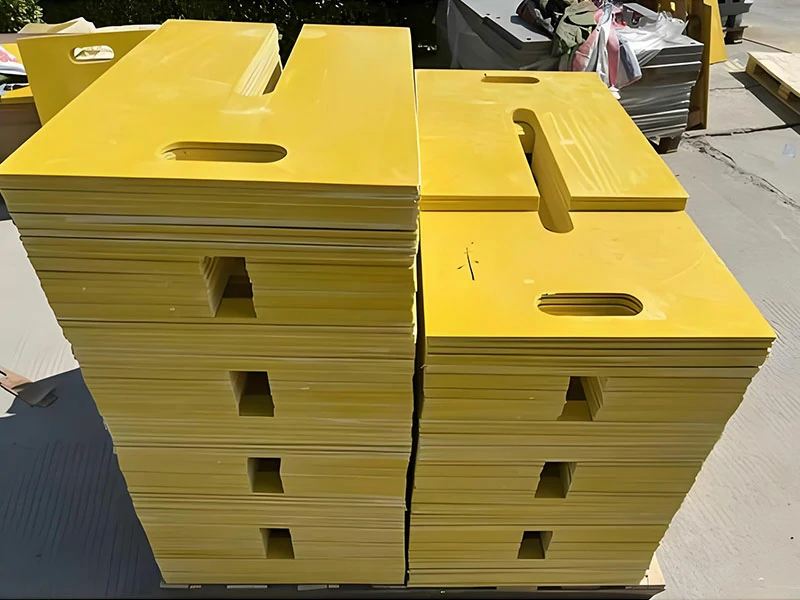
A successful composite molding cycle consists of multiple critical phases: fast approach, slow closing, compression, dwell (curing), and return. The transition from fast approach to slow closing must be seamless to prevent displacing the material charge. During the dwell phase, the press must maintain exact tonnage to compensate for the material’s shrinkage and the exothermic reaction of the curing resin.
Furthermore, the decompression phase at the end of the cycle must be carefully controlled. Rapid decompression can cause the part to blister or delaminate due to the sudden release of trapped gases and internal stresses.

Thermal management and platen temperature uniformity
The curing of thermoset composites is entirely dependent on heat transfer. If the mold platens have hot or cold spots, the resin will cure unevenly. Under-cured areas will result in weak, tacky parts, while over-cured areas can become brittle or suffer from thermal degradation. Maintaining platen temperature uniformity within ±1.5°C to ±3°C across the entire mold surface is a strict requirement for high-quality composite manufacturing.
Depending on the required temperature profile, presses can be equipped with electric heating rods, oil-heated platens (for high uniformity and cooling capabilities), or steam systems.

Vacuum systems and degassing (burp) cycles
Entrapped air and volatile byproducts from the curing resin are the primary causes of porosity and surface defects in composite parts. To eliminate these defects, hydraulic presses utilize two main techniques: mechanical degassing (burp cycles) and vacuum chambers.
A burp cycle involves the press slightly opening the mold (typically 5-15mm) at a specific point during the curing process to allow trapped gases to escape, before immediately reapplying full tonnage. For highly critical parts, the entire mold is enclosed in a vacuum chamber that extracts air down to a specific mbar level before and during compression.
Selecting the right press architecture for composite tooling
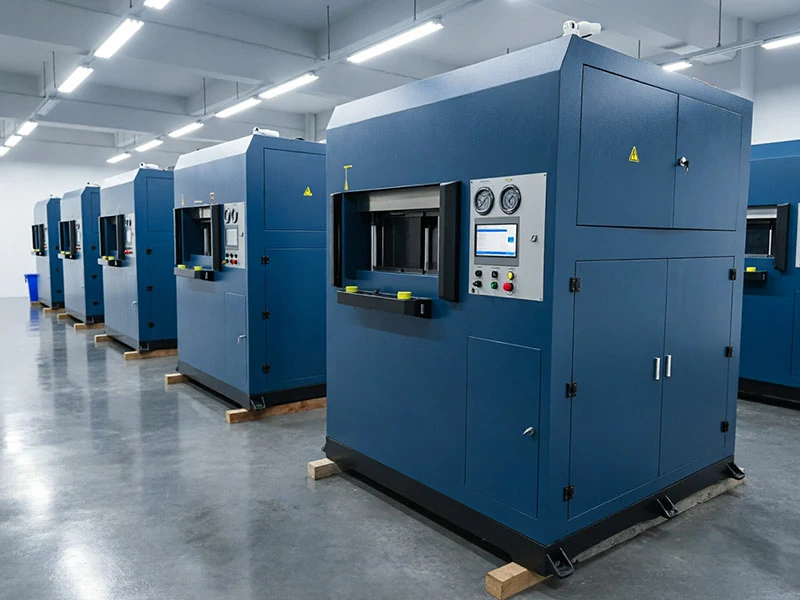
The choice of press frame geometry is dictated by the mold size, the required tonnage, and the potential for off-center loading. Composite molds often have complex core and cavity geometries that do not distribute pressure evenly across the platen. Selecting a frame that resists deflection under these asymmetric loads is crucial for maintaining part wall thickness and dimensional accuracy.
For specialized applications, such as continuous laminating, thermoplastic sheet forming, or laboratory-scale material testing, the press must offer maximum accessibility and flexible tooling integration.
Explore in-depth technical articles on composite manufacturing processes and material innovations at CompositesWorld .
Frequently Asked Questions
Technical insights into composite material molding, compression molding process parameters, thermal management, and hydraulic press architecture selection.
SMC (Sheet Molding Compound) consists of longer glass fibers embedded in a resin sheet, offering higher tensile and flexural strength, making it ideal for large, structural, or Class-A surface parts. BMC (Bulk Molding Compound) has shorter fibers and a dough-like consistency, allowing it to flow into finer, more complex cavities with tighter tolerances, commonly used for electrical components and intricate hardware.
Thermoset resins cure through an exothermic chemical reaction triggered by heat. If the mold platens have temperature variations (hot or cold spots), the resin will cure unevenly. This leads to internal stresses, warpage, surface blemishes, or incomplete curing (tackiness). Maintaining uniformity within ±1.5°C to ±3°C ensures consistent mechanical properties and dimensional accuracy across the entire part.
During the compression of composites, volatile gases and trapped air can cause porosity. A “burp” cycle is a programmable hydraulic sequence where the press pauses its closing, slightly opens the mold (typically 5-15mm) to allow gases to escape, and then immediately reapplies full tonnage. This requires highly precise hydraulic valves and position transducers to execute the micro-movements accurately without disrupting the material flow.
Fiber washout occurs when the resin flows too quickly during the initial closing stages, pushing the glass fiber reinforcements away from certain areas of the mold, creating weak spots. It is prevented by utilizing a hydraulic press with multi-stage speed control—specifically, slowing down the closing speed just before the material makes contact with the mold, allowing the compound to flow evenly and predictably.
Composite molds often have asymmetrical cavities or deep cores, causing the hydraulic force to be applied unevenly across the platen. This off-center loading creates a bending moment that can cause the platen to tilt (angular deflection). If the press frame lacks sufficient rigidity, this leads to uneven part thickness, flash (material leaking out of the mold), and accelerated wear on the guiding system. Proper frame selection is essential to counteract these forces.
At the end of the cure cycle, the composite part and the mold are under immense hydraulic pressure and thermal expansion. If the press opens too quickly (rapid decompression), the sudden release of pressure can cause the part to blister, delaminate, or stick to the mold. Controlled slow decompression gradually relieves the hydraulic pressure, ensuring the part remains intact and the mold opens smoothly.